

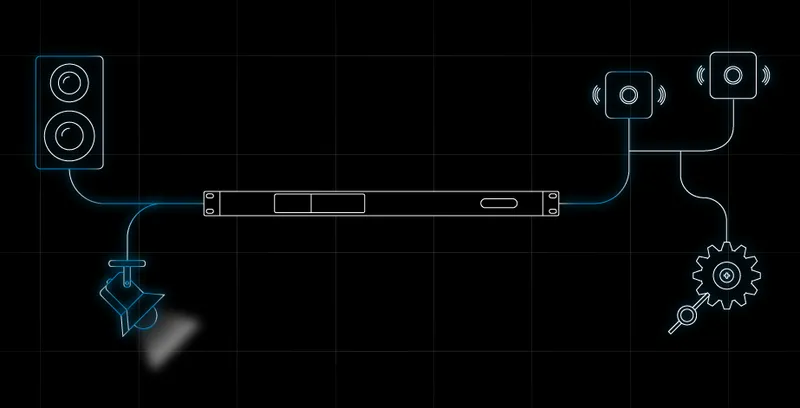

Active Damping Control
With modern systems growing larger in size, the resistance added by lengthy cable runs starts to become an issue. With Active Damping Control, the effects of the resistance added by the length of the loudspeaker cable are automatically balanced.
How does Active Damping Control work?
By entering the length and the diameter of the copper cable used, the damping build-up of the cable is automatically calculated and eliminated.
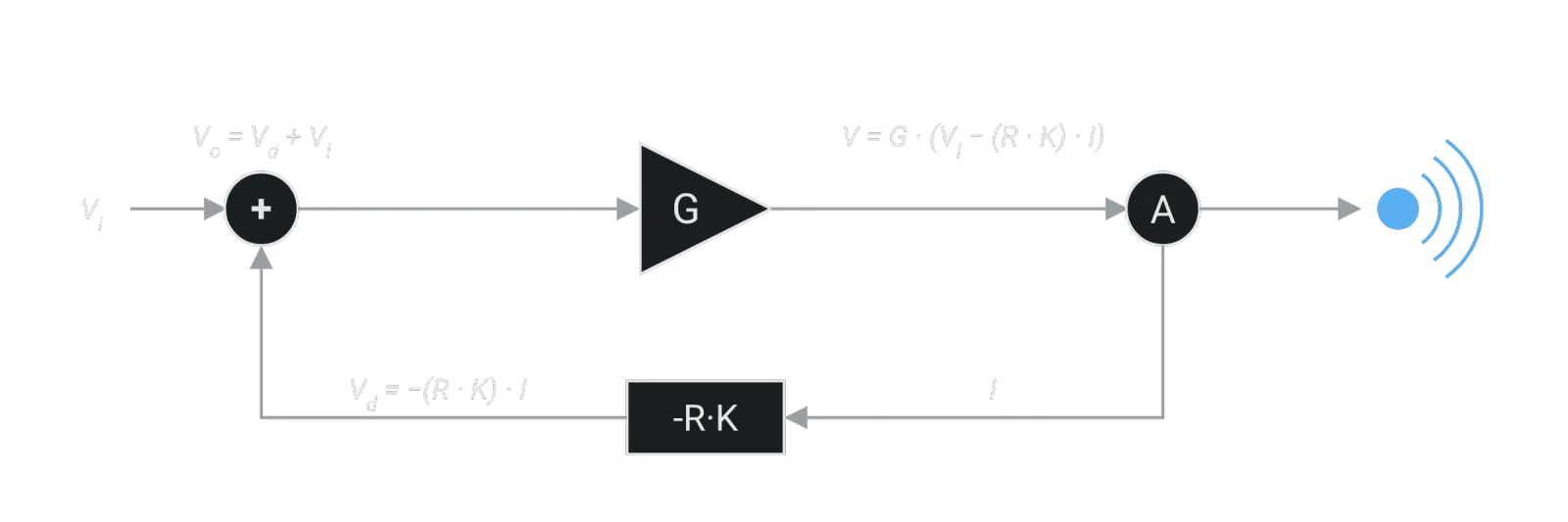
The block diagram shows the feedback path: the output current I passes through a −R·K block, giving Vd = −(R·K)·I; this is added to the input Vi (Vo = Vd + Vi) ahead of block G; the line from G to A is labelled V = G·(Vi − (R·K)·I).
Key facts
- Addresses the resistance added by lengthy loudspeaker cable runs in large systems.
- Input required: the length and the diameter of the copper cable used.
- The damping build-up of the cable is automatically calculated and eliminated.
What are the advantages of Active Damping Control?
- Problem solved: Active Damping Control automatically balances the effects of the resistance added by the length of the loudspeaker cable.
- Simple setup: you only need to enter the length and the diameter of the copper cable used.
- Automatic compensation: the damping build-up of the cable is automatically calculated and eliminated.
More Technologies
Alimentatore PFC Switch ModePowersoft è sempre stata molto attenta al risparmio energetico e il Power Factor...Open →AnyMATE™Modern pro-AV systems are increasingly smart and connected - except for the speaker line....Open →Class DHow Class-D amplifiers work: input filtering, PWM, MOSFET switching and output filtering,...Open →DPC Differential Pressure ControlThe Differential Pressure Control technology integrates advanced functionalities possible...Open →