
Powersoft Anchors High-Performance Residential Listening Room With Restrepo Innovations
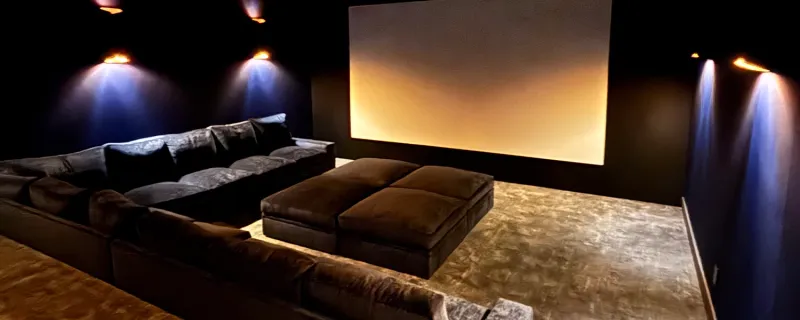
Scandicci (Florence), September 14, 2026 – A recently completed residential listening room designed and installed by Restrepo Innovations positioned amplification at the center of its performance and operational strategy. The private client approached the project as a long-term investment in daily listening, so the room was conceived as a dedicated environment within a larger home, with architectural decisions driven primarily by acoustic performance.
The listening room was constructed as a concrete enclosure to maximize isolation from the surrounding structure. The mass and rigidity of the space provided predictable low-frequency containment and reduced external noise intrusion, but the reflective surfaces introduced acoustic and thermal considerations that required careful coordination. In collaboration with design partners, Restrepo Innovations evaluated loudspeaker placement, acoustic treatments and equipment infrastructure simultaneously to avoid compromises later in the construction process. The amplification system needed to operate reliably within this dense architectural envelope while supporting extended high-output listening sessions.
As a result, Restrepo Innovations selected Powersoft based on technical capability and prior field experience. Restrepo Innovations had previously deployed Powersoft alongside Grimani Systems in demanding applications and was familiar with its behavior under sustained load. Powersoft’s ability to dynamically allocate power across channels, aligned with the room’s performance goals. The system was specified not simply for wattage, but for its ability to maintain composure and control under real-world program material.
The dynamic power-sharing design allowed the total available power to be distributed according to instantaneous demand rather than fixed channel assignments. The architecture ensured that when a specific channel encountered transient peaks, the required current could be delivered without compromising adjacent outputs. The approach reduced the need to overspecify multiple amplifier frames solely to preserve headroom. The result was a system capable of sustaining realistic listening levels without compression artifacts or thermal instability.
The integration with Grimani Systems loudspeakers allowed the amplification platform to support the system as a unified acoustic environment rather than as discrete components. The predictable power delivery and control structure ensured that the loudspeaker system performed as engineered across the full bandwidth and dynamic range.
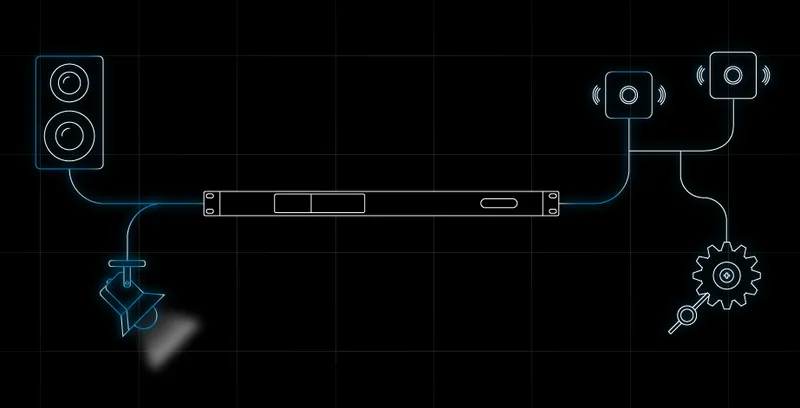
Powersoft’s network integration capabilities were equally important to the project’s long-term strategy. Each amplifier frame includes a dedicated Ethernet connection, enabling full remote monitoring and control through the system network. The integration allowed Restrepo Innovations to observe amplifier health, temperature, load conditions and signal presence in real time. For Restrepo Innovations, maintaining visibility into the system’s operational state supports preventive maintenance and faster response to irregularities.
The operational transparency directly supports Restrepo Innovations’ concierge service model. Restrepo Innovations positions itself as the single point of accountability for performance and service across the entire system. The remote monitoring infrastructure allows Restrepo Innovations to verify that the system is operating as designed without requiring an on-site visit. The approach reduces client exposure to unexpected downtime and reinforces long-term system stewardship.
The physical form factor of Powersoft also influenced the specification. The high channel density within a compact chassis reduced the required rack space and simplified electrical distribution. The reduced footprint was particularly relevant in a room where architectural and interior design considerations were tightly managed. The consolidation of channels into fewer frames contributed to cleaner cable management and fewer potential failure points.
The platform’s thermal efficiency enabled stable operation within the concrete enclosure. The reduced heat loss from the output stage minimized the burden on the room’s cooling system and reduced the risk of heat-related performance drift. The lower thermal output also helped maintain quieter mechanical operation from supporting infrastructure systems. For a listening environment intended for extended daily use, minimizing background noise from equipment was a functional requirement rather than a luxury.
The cost-to-performance relationship was evaluated in terms of lifecycle value rather than initial unit price. Although the platform occupies a premium position in the amplification market, its power density and channel flexibility reduced the total hardware required. The consolidation of amplification resources lowered rack space, power consumption and long-term service complexity. When calculated across projected years of operation, the specification aligned with the client’s expectations for durability and consistency.
The final system is presented to the client as a unified solution under Restrepo Innovations rather than as a collection of individual components. The amplification platform operates as a control and stability layer within that broader ecosystem. The remote visibility and dynamic power management characteristics support the project’s objective of delivering extended, fatigue-free musical engagement.